Thursday, November 17, 2016

Cinnabar Gets A New Prom Dress (Well...new sails actually)


Why is this man making a "snow angel" on a crisp, new mainsail in the middle of a tropical  park?


After 14 years Cinnabar's sails needed replacing, especially our mainsail which started delaminating during our journey across the Pacific. We fretted over the mainsail during most of our cruising season, babying it and hoping it would last until we ordered our new sails. And we even poked holes in it to drain water out during one particularly nasty squall! 

After we arrived in the Marquesas this April, we ordered a new mainsail and working jib from North Sails New Zealand, the same loft who had made our original sails. The value of the NZ$ compared to US$, and an additional discount provided by North made ordering sails from NZ our best option. After lots of email and Skype communication with the North NZ rep, nerve-wracking decision-making (Dacron? Spectra? Carbon? What size jib? What options? So much money! Is using a remote Sailmaker a wise choice?) we decided to go with improved/updated versions of the sails we had before and what had served us so well, the Spectra laminate material.

We then cruised around the Tuamotus for a few months while our new sails were being made with the intent to eventually pick them up in Tahiti.

Delivery day in Tahiti, October 10,  was exciting. 
Hello, I love you, won't you tell me your name?

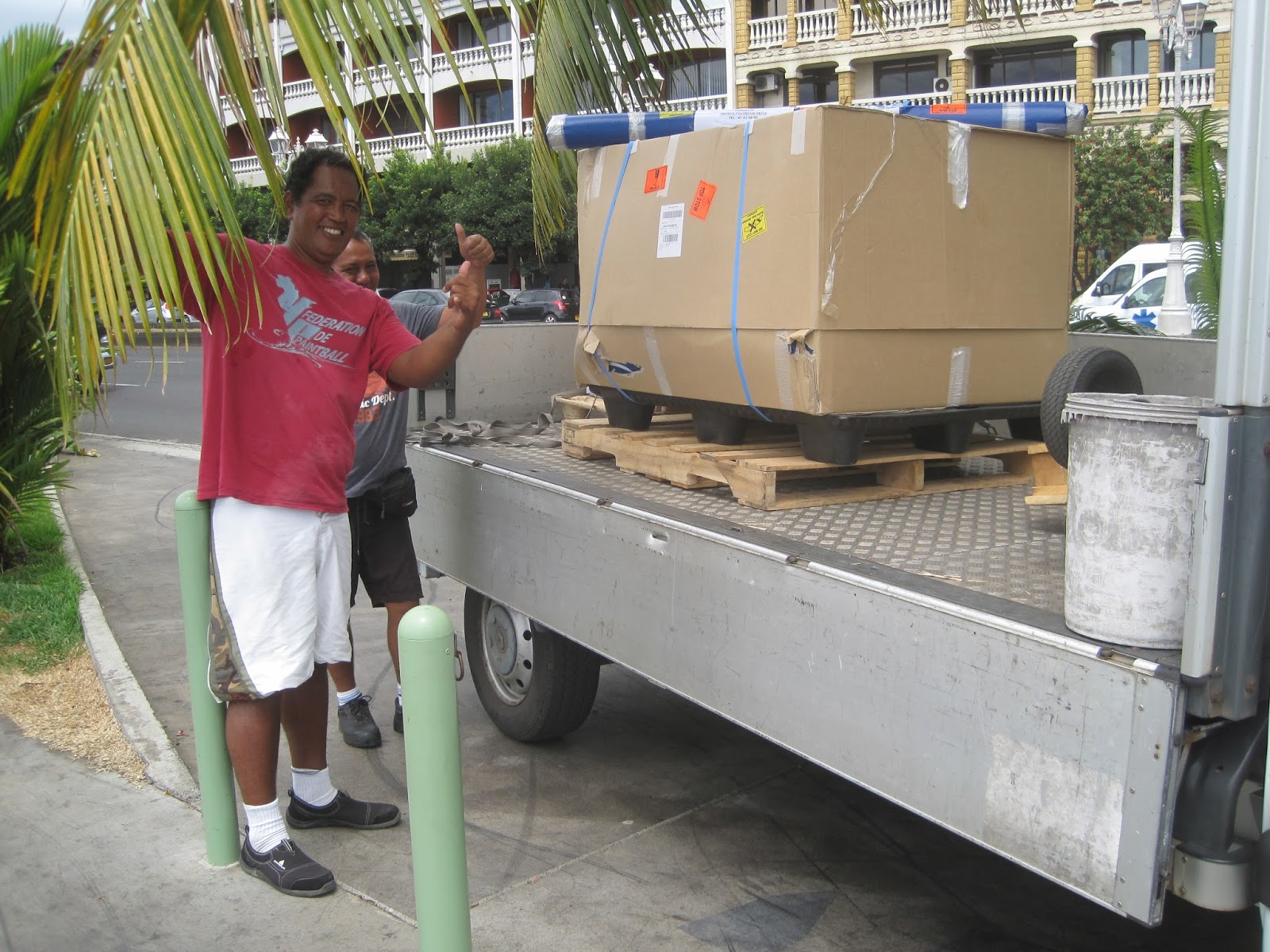
The nicest guys in the world delivered our sails (and other gear packed along with them including 10 meters of Sunbrella) and insisted on delivering the gigantic and heavy box right to our boat! 

Sylvia with Henri and Ellis, box on dock next to Cinnabar in the background.


The first order of business was to take both old and new mainsails over to the nearby park...

New sail in dock cart, old sail on hand cart

...where there was room to lay them out, compare them, and identify where to put the spreader patches on the new sail. (Spreader patch - placed where the sail rubs up against the spreader and gets worn.) 

New sail on top of old to compare.

The sails weren't exactly the same size, but very close; the new sail was slightly bigger by design due to expected shrinkage over time of the old one. In fact, the leech of the old sail was about 14" shorter (!!) than the new sail so took a bit of calculating (only four freaking hours!) to guesstimate where to put the patches.


Unflattering photo of Sylvia locating the spreader patch on the old sail (underneath), marking it on the new, then moving it up four inches.

It took all day and it was HOT, but we finally finished and Tom was able to zen out with the new mainsail. All I wanted to do was take a cool shower and have a cold rum drink.


You will be a perfect fit...ohmmmmm...

Now all we had to do was install it. All 132 lbs of it.Ugh.

It was incredibly hot during the days, also windy (from abeam) making mainsail installation impossible, but the wind usually died around 6:00 p.m., so a couple of nights later we waited until the wind died and the heat subsided and we hoisted the new mainsail to take a look. Tom "jumped" the halyard at the mast while I used the winch to raise the sail.


It's a bit longer on all three sides than the old sail, but it looks like it fits.


Lowering it and flaking it on the boom to store until ready to sail.

Now it was time to put up the jib. Luckily we had a calm morning so we knew it would be a good time to hoist. It was so much easier to install the (91 lb) jib than the huge mainsail. 


Out of the bag and ready to hoist.


She's a beauty!! 

With the new sails installed we were just about ready to sail to Raiatea where we would store Cinnabar for cyclone season.


Fast forward one month and here are the sails pulling us from Papeete to Raiatea:

New sails in action. (Luff tension on jib should be tighter as the wind increased.)
And wonder of wonders, the spreader patches were perfect! 

The boat traveled swiftly along her 120 nm course in the moderate winds (10-14 kts TWS) and seas (1 m) of her first sea trial of the new  "prom dress". So far, the sails seem to be a proper fit. 

The overall duration of the new sails process, from initial quote request to first sail of the product was 8 months. The total emails exchanged was just over 100.


Saturday, October 22, 2016

The Sights, Sounds and Smells of Papeete


Cinnabar (red boat of course) at the dock
It was quite a culture shock to arrive in downtown Papeete after being in the remote Tuamotus for months. Before approaching the harbor entrance we were required to call port control to make sure we wouldn't have to share the somewhat narrow entrance with any of the numerous ferries and other LARGE commercial vessels that frequent the harbor. As we entered the very busy harbor into downtown Papeete we caught a delectable whiff of toasting coconut and thought "We might just like this city after all."

Based on recommendations from our friends on SCOOTS we headed for the new city marina which is smack in the middle of the downtown. In fact, when you exit the marina gate you have to look carefully both ways because you'll be stepping out right onto the main promenade which always seems to filled with cyclists, skateboarders, runners and pedestrians.

We had to laugh at the no-handrail promenade, something you will probably never see in the U.S. When we asked the marina office about it they assured us that there is a dock ladder at each end "because sometimes a kid falls in." Uh, OK.  


Don't fall in!! Sure wish I had a picture of the kids popping wheelies just 6" from the edge.

One day Tom saw a young skateboarder lose his board into the water. Oops! No problem. With an audience of several cruisers and numerous pedestrians he stripped to his skivvies, jumped into the water, borrowed a mask and snorkel from a nearby boat and retrieved his board.

Papeete is a city of aromas, most of them good. When we first stepped out of the marina we were struck by the strong fragrance of flowers. The city is filled with Plumeria trees and Tiare plants (Tahitian gardenia). The first time I went to the downtown market I smelled it long before I saw it because one section of it is filled with flower vendors selling stalks of exotic (to me) flowers, arrangements, leis and beautiful crowns called heis


The sweet-smelling leis and heis

Then there are the numerous restaurants, cafes and bakeries that fill the city which make it smell especially yummy in the mornings when baguettes and croissants are fresh.

Papeete is a very noisy city with all the ship's horns, street traffic (that starts at 04:00) and sirens. The pin pon pin pon (that's the sound a French siren makes) of the ambulances is nearly a constant. At night, well, we are across the street from a karaoke bar; need I say more? 

One morning I woke up, looked out our companionway, and was met by a wall of hundreds of people looking our way. A 1,000 foot cruise ship had arrived and was parked right behind us! For several days these huge monsters came and went (from Hawaii bound for Australia or New Zealand), with them thousands of pale passengers, loud announcements, bells and generators. 

The day we arrived we were happy to be greeted by our friends ATHANOR, MALUHIA and NAOMA waving at us as we motored by . As we were about to pull into the slip MALUHIA Dave calmly remarked "You might want to put out some fenders." Doh! That's what happens after 5 months away from a marina. We got safely docked with a little help from our friends, checked into the marina, enjoyed a long, hot shower courtesy of the facilities, and walked down to the Roulottes for dinner. 

The Roulottes are food trucks and there are about 30 of them in the nearby plaza serving a variety of food such as fresh fish, pizzas, chow-mein, crepes, burgers, the list goes on.


         Food trucks aren't "trending" here, they are a way of life. (photo courtesy of trip Advisor)

The next day I caught the free shuttle from the nearby Visitor Center to the gigantic Carrefour store on the other side of town; it's kind of like an upscale Walmart with lots of beautiful groceries, cheese, fruits, vegetables, electronics and home goods. I felt like I was in Disneyland with all the choices.

Sylvia finds her "sole" mate at the Carrefours. (Actually, it is a huge Opah.)
In addition to the huge Carrefours there are hundreds of stores and shops that sell everything you can imagine. Very close to the marina there is a fantastic City Market, a kind of farmer's market, that sells fresh produce, fish, meat, prepared foods and all sorts of goods and souvenirs including woven hats, perfumes, scented oils, fabrics, jewelry, clothing, etc.


You can even outfit yourself like a Tahitian dancer.

Transportation: there is an OK bus system in Papeete and Tom has taken the bus to Pt. Venus twice to go kiting (but he had to hitch-hike back once because the buses stop early on the weekend). 

Very popular kiting beach at Point Venus
Taxis are VERY expensive here. We were invited to a party at the marina on the other side of town and we ended up renting a scooter for the day ($33) which actually turned out to be slightly cheaper than a bus-to-and-taxi-back option. Plus we got to go sightseeing around the island on our scooter. Mostly we walk, borrow the marina's lender bicycle, or utilize the free shuttle from the Visitor's Center that runs to the 2 Carrefours three days a week. This free shuttle is a temporary program paid for by the Carrefours to assess utilization numbers. I hope they decide to make it permanent as it's a huge benefit to cruisers.


Sightseeing around Tahiti
One of the reasons we came here is because Papeete is a great place to arrange things and get boat work and repairs done. In fact, we ordered our new sails here and they arrived a few days ago from New Zealand. So in addition to sight-seeing and walking around town we have been doing some serious boat work. More about that subject later. And notice how I didn't include "Taste of Papeete" in the title. We're still assessing the restaurants; so far the brew pub (yes!! good beer at last!) is our favorite.

When people ask us how we like Papeete I always think of that part of the Green Acres song that goes "da da da DA da...The Chores! da da da Da da...The Stores!"


Monday, October 17, 2016

We're Stars!!


We've got a long post about Papeete just about ready to be published, but in the meantime you can see Cinnabar (briefly) in our friend NAOMA'S You Tube video. Our cameo is about 2 minutes into the video.


Or if you prefer to watch it via You Tube here's the link: Traditional Tahitian Crocodile Chicken, Oui!

Monday, October 3, 2016

Why Must We Always Depart Motus At Night? - Fakarava to Papeete


GPS track to Tahiti - about 240 nm.


Last Day in Fakarava - After much gnashing of teeth (Tom) and stomping of feet "We ARE leaving today!" (Sylvia) and a good weather window* to leave Fakarava, we decided that Monday, September 12 would be our "day" (snort) of departure. 

*Good Weather Window - Ideally, all these factors align to make a good passage: 
1 - Leaving the atoll. We've talked in the past about the importance of timing one's arrival and departure into/out of the atolls. Depending upon current and wind the usually narrow passes can have standing waves and powerful currents, making the transit uncomfortable to downright dangerous. Typically a transit during slack water is the best, with slack being roughly twice a day, so we try to time it perfectly, although there is no completely accurate way to time the tides and currents because they are affected by wind and weather which is always changing. And one should always transit a pass in the daylight!!
2 - Wind. We want enough wind during the journey so that we can sail instead of motor, but not so much that we get pummeled. Oh, and from a comfortable direction helps too, i.e. not on the nose and preferably from the beam (side) or aft quarter (behind but not directly behind).
3 - Ocean Swell. We hope that the ocean swell is not too big and is coming from behind rather than slapping the boat from the front.
4 - Weather. No rain please. A bright moon helps visibility.


I'm not sure I would have been able to drag Tom out of Pakokota except that the owner Matthieu was planning to leave that day as well, also to sail his boat VISKUS (means Fish Kiss in Tahitian) to Papeete with two crew, Lucas and friend Apolline. So we had the opportunity to buddy boat which seemed fun. With two boats so different in size and style it was doubtful we'd see them much during the transit, but maybe we would at least be in VHF radio range.

That morning I went into the town of Rotoava to do a last bit of shopping and so Matthieu could pick up supplies of water and food (a huge bag of baguettes and cheese) for the trip. 

Then, when we got back around noon Matthieu and Tom donned their SCUBA gear to put some finishing touches on their mooring. 

Mattieu and Tom - 10 more turns = final 2 ft.


The clock ticked on.

Slack tide for departure that afternoon was 18:30 (6:30 p.m.), the end of an ebb tide, so if we got there early, i.e. DAYLIGHT around sunset (5:30 p.m.), we should be able to slide right out with the current. (It's not recommended to transit Tuamotu passes in the dark, although you might remember that we did just that when we left Tahanea.) Anyhoo, as luck (poor planning?) would have it, we didn't even weigh anchor and leave the anchorage until 5:30 p.m., just after sunset. 

We followed VISKUS in the deepening darkness from the anchorage to the North Pass of Fakarava. We were a little worried as we were an hour past slack tide, it was now DARK, and we were anticipating having to push through an incoming tide IN THE DARK. As it turns out we had about 2 knots of outgoing current with us (a good thing); so much for the tide estimator. We followed VISKUS through the pass, the water going from 38 feet to over a thousand in about 30 seconds. I was fretting and nervous the entire time, but in the end our exit out of Fakarava was uneventful. Whew!

We had it planned perfectly: We figured it would take us about 36-40 hours to do the 240 mi. trip. If we left late in the day we would arrive at Tahiti during early daylight making a direct entrance into the marina possible.  

We had nearly perfect tradewind weather for our trip (TWD 105 M, TWS 15-22 kts), a bright almost-full moon, enough wind for sailing, and a not-too-uncomfortable 1.5 meter swell on the beam. We passed VISKUS after a few hours but were able to maintain radio contact with them throughout the entire trip. 

We were lucky, there were no squalls and we had enough wind so that we never had to turn the motor on. The swells (from SSE) got bigger during the day which made for some fun hand-steering but also a few splashes into the cockpit. It also made for better boat speed and it was looking like we would be arriving much earlier than we'd planned.


Point Venus on the northern tip of Tahiti (photo courtesy of Wikipedia/NOAA)

Once again in the dark: Early in the evening of our second night it was clear we were going to make Tahiti in the wee hours of the morning. Negotiating an unknown channel into the marina at night wasn't an option. However, the bay at Point Venus (Matavai Bay) in the north could be safely negotiated at night, especially with the bright moon, so when we arrived at 02:00 we navigated around the reef, into the bay, dropped our anchor and slowly drifted back. And back. And back some more. Oops, the anchor was obviously not holding. So we hoisted it and circled back around for a second try. We got it right the next time and after making sure the anchor was secure we celebrated with showers and a quick shot of rum. After turning on the anchor alarms we enjoyed a few hours of restful sleep before daylight. 


Good morning! View of green, mountainous Tahiti seen from CINNABAR anchored in Matavai Bay.

Later that morning we called VISKUS on the radio. They had opted to slow down and not enter until daylight. We watched them sail by as they headed for their reserved mooring at the nearby Tahiti Yacht Club.

Point Venus: So named because Capt. Cook anchored here in 1769 to watch the Transit of Venus. (click on the link for a fascinating explanation of this important event.) In fact, this was the primary objective of Cook's first voyage in ENDEAVOUR and was commissioned by the Royal Society of London. He established an observatory there called Fort Venus. 

Matavai Bay was so pleasant that we decided to spend another restful day and night there before heading into the city of Papeete. We wondered how we would like Papeete after 3 months in the relative wilderness of The Tuamotu Archipelago. 

Papeete update to follow. (Hint: Shopping!!!!)


Beautiful sunset with Moorea in the background while anchored at Point Venus


Trip Stats:
Engine - 4.7 hours (2+hrs. motoring out of Fakarava, motoring into and anchoring Point Venus)
Trip Log - 237 miles
Distance - 242 nm
Avg Speed - 7.5 
Time - 32.5 hours


Monday, September 12, 2016

North Fakarava - Bonjours et Adieux (Hellos and Goodbyes)


One of our favorite anchorages so far - Double rainbow over Pakokota in east Fakarava

(The inside calm water belies the racous open ocean on the other side of the palm trees, only a mere 350' away - the atoll is very skinny indeed.)
(Sylvia)
Provisioning in Fakarava: We've traveled up and down the motu of Fakarava a couple of times in the 2+ months we've been here. One of the benefits of this motu is that it has a town for provisioning. The town of Rotoava is in the NE corner of Fakarava and it is there that cruisers can anchor or grab a mooring (free) and visit the town to provision and stock up (3 stores and an excellent fruit/veg stand), leave garbage at the very nice dinghy dock, get fuel/gas/butane, use internet (at Fakarava Yacht Services), visit the ATM at the post office, eat at some restaurants, and as we've already seen, rent a bicycle. One of the down sides of Rotoava is that the prevailing winds come from the SE and, after a fetch of 30 miles, the anchorage can become very bouncy and uncomfortable. It's best to visit Rotoava when the conditions are very flat and/or when the winds are more northerly, hence our stop along the way...

 We "discover" Pakokota Yacht Services: Free wifi and free moorings! The first time we went north we stopped at an anchorage along the way that we'd heard about over the cruiser's HF radio net. It was about 11 mi. south of the town, more protected (less bouncy) than Rotoava and it actually had some internet and yacht services, so we decided to give it a try. Unlike most other motus, Fakarava has fairly well-marked channels, so we had an uneventful (although windy and fast) trip up the channel, navigating from green to red buoy, until we saw NAOMA ahead of us drop their sails and motor into an anchorage. By the time we furled our jib they already had their anchor down and as we approached the anchorage looking for a good spot to drop the hook we heard someone hail us on the radio. "Red boat, red boat, this is Matthieu at Pakokota, you may take that free mooring." Wow, what service! 


Beautiful Pakokota, and check out that antenna!
(The top antenna is the microwave backhaul to bring internet from town (6 nm away) to the resort and anchorage. The lower antenna near the base is for wifi.)

After determining that the offer was for real, we grabbed the mooring and told NAOMA we'd buy them a beer on shore for leading the way yet again. Once on shore we met Pakokota owners Matthieu and Agnes. Matthieu, who is French and speaks very good English, was happy to tell us about their services. Turns out the internet is free, you just need to go in and get a password from them. There is also a common room/bar where you can purchase beer and a few soft drinks. He sells butane (propane substitute) on site, diesel when he has it (usually has a barrel, otherwise can get in town), and for a small fee will drive cruisers into town for gas, provisions, and other errands. They are also a pension and have a bungalow to rent if anyone feels they must get off the boat. 

Agnes can do laundry on site and the charge is less than anywhere else we've seen. They also provide dinners (order in advance) and we enjoyed some excellent meals of items grilled on the BBQ and hamburgers served with a mountain of pommes frites.

For our first visit at Pakokota we were there for just a couple of nights to check it out. We discovered that Matthieu, an antenna engineer and professional diver in a past life (actually, I think he still does diving for the gov't maintaining channel markers), is the one who installed the wi-fi antenna at Pakokota as well as a relay antenna in the middle of the whole atoll that allows South Fakarava to have internet. So thanks to Matthieu there is internet to the rest of Fakarava, not just in Rotoava. He also personally installed the mooring buoys in his anchorage and assured us of their strength. (Yes, we asked!) 


Matthieu and his daughter Hani. Someone said of him, "For Matthieu there are no problems, only solutions."


On our second day there Matthieu drove Nicole and Ryan (NAOMA) and me into town to get gas for the outboards, to pick up our fruit and veg orders from Faka Faapu (more on that later), and to visit the three magasins (stores) in town for supplies. 


Matthieu and his "limousine" for transport into town.
(The rust is barely holding together!)

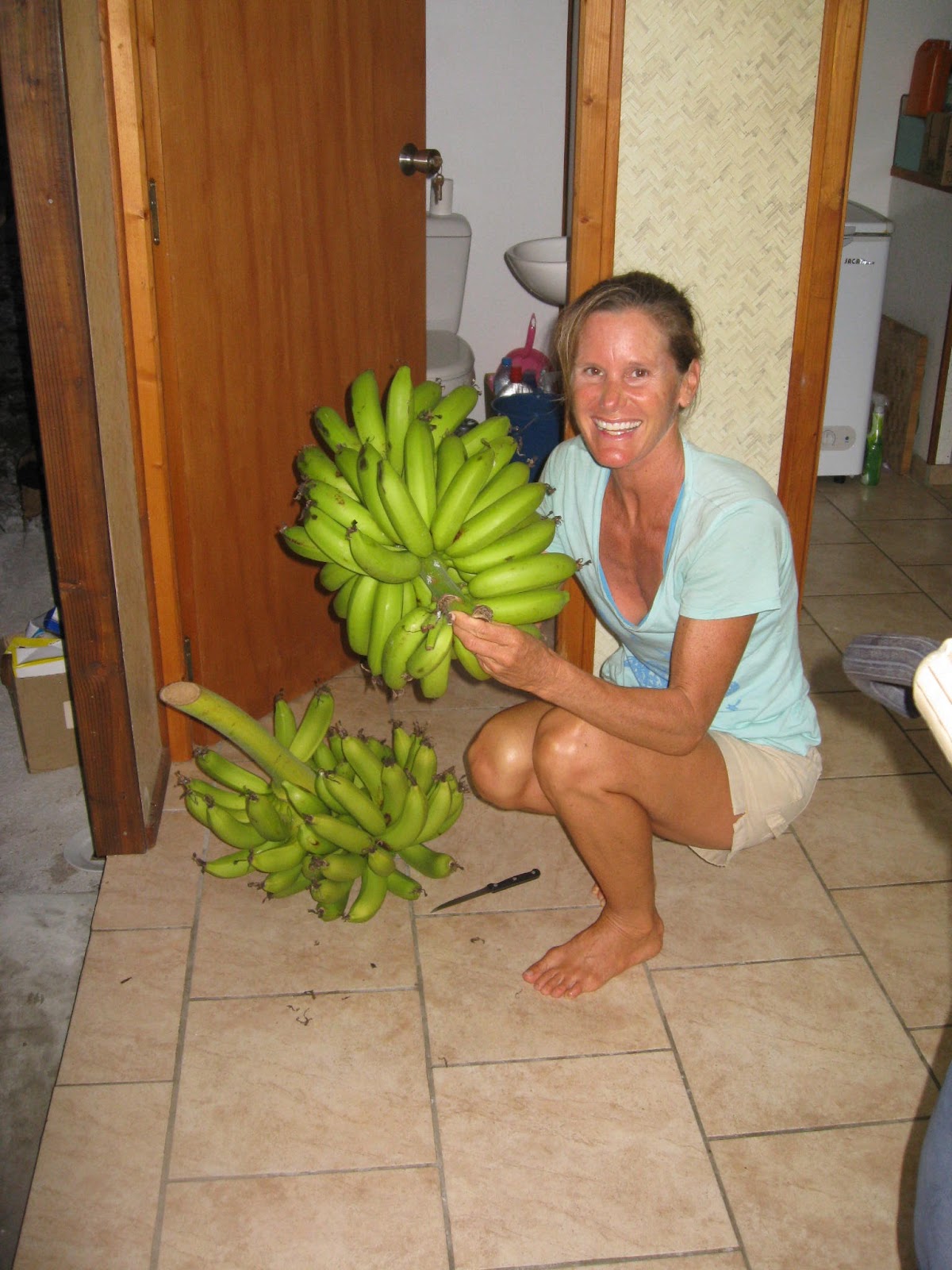
He also hooked us up with the only guy who sells stalks of bananas, so Nicole and I split a stalk. 


Nicole loves her bananas. Can we eat them before they all ripen? Hope you like banana bread!

We truly enjoyed meeting Matthieu and Agnes and loved Pakokota but our friends JACARANDA and MALUHIA were moored in Rotoava and reported that conditions were calm and flat so we thought we'd better head up there to check it out. 


Tom presents an American flag to Matthieu and Agnes.

Town of Rotoava: The town provides moorings that we heard were just installed this year and quite strong, so when we arrived and found one available and we grabbed it. We were glad to get a mooring because there are a lot of coral heads in the anchorage and one must pick an anchor location carefully and float buoys from the anchor chain to avoid wrapping chain around bommies. 

We were delighted to see that the dinghy dock is easy to get to and, unlike Marquesan wretched/rusty/loose/stab-the-dinghy ladders, Rotoava's ladders to the concrete pier are robust and easy to climb. 


Dear Marquesas, could you PLEASE make dinghy docks and ladders like this? 

The town is not big and it's easy to walk from one end to the other. We had already provisioned from Pakokota so all we really needed to do was order fresh baguettes and croissants for the next day (the magasin boulanger sells out early). We'd heard that the July 14th celebrations were supposed to be happening, but that was all a bit of a bust, so we rented bicycles instead for a day (as seen in a previous post). As mentioned in that post, our favorite restaurants were La Paillote and Rotoava Grill. We've heard the Pearl Havaiki is very good, but we were never in the mood to dine inside, preferring to have a view instead. Maybe next time. 

Faka Faapu: This is a fruit and vegetable stand owned by the charming Sophie. I was able to place an order in advance via sailmail email and to pick up my box of fresh food when Matthieu drove me into town. 


Sophie provides a wonderful service to cruisers. 

In addition to my order I also purchased some fresh herbs, green peppers and lettuce from local gardens. Her prices are the same as the magasins in town; she said she started the advance order service because cruisers used to mob her stand as soon as the fruit and veg was unloaded from the supply ship COBIA and it made her crazy, so order in advance if possible. She also provides to the restaurants in town. For outstanding service call or email her to get the price list: Sophie Devillechabrolle
email: fakafaapu@hotmail.fr 
PH: 87 32 56 78 


Fakarava Yacht Services: we rented bicycles from them, used some internet, and purchased gasoline. They also have a laundry service, sell fresh eggs, and provide airport transfer services. 

While we were in Rotoava there were some July 14th celebrations taking place and the anchorage was a bit noisy at night with people playing loud music, etc. Also, the winds were supposed to clock back around to the SE and we didn't want to get bounced around, so after a couple of days in Rotoava we'd had enough of the "city life" and went back down to Pakokota.

Back in Pakokota: This time when we arrived there was a glut of boats in the anchorage including an Italian charter Cat and a couple of very friendly French boats with kids. Word had gotten out and Pakokota was a popular place! We spent the next 1.5 weeks enjoying meeting new friends and re-connecting with old ones before heading down to South Fakarava for diving and kiting.


International gathering of cruisers for happy hour. We represent the U.S., France, Italy and French Polynesia. (And Chuck has an Irish passport.)

Chuck and Tom - we have coffee aboard JACARANDA

We haven't seen Nico of YELLOW FEATHER since we left Nuku Hiva. We first "met" him by radio as we were crossing the Pacific. Who says you need a dinghy with a motor?

Pakokota Trois: And here we are now, third time in Pakokota. We like it here because Matthieu and Agnes are wonderful and helpful, the internet connection is very good (this is where I've done the previous 4 blog updates), and we're close to town without actually having to be IN town. This time when we arrived NAOMA was here...


Nicole (NAOMA) sups by to say hello

...along with COCCINELLE, a French boat that was anchored here to get some boat work done before their long sail to The Australs. We'd seen COCCINELLE (means Ladybug, pronounced coke-see-nell) a couple of times before and knew it was a family of four with two adorable girls aboard. 


Camille (9) and Apolline (7) of COCCINELLE

However, Matthieu was not in Pakokota; he was in the neighboring motu of Apataki to pick up his sailboat and bring it back to Fakarava, so Gilles of COCCINELLE offered to drive us into town to provision up after our 4 weeks in South Fakarava. We planned the trip on the day the supply ship COBIA arrived. The dock was very busy with cars and trucks arriving to pick up their goods, as well as cruisers standing in line with fuel cans to buy diesel directly from the ship.


The COBIA supply ship offloading goods.

We ran into Simon and Johan, two of four very interesting Swedish guys we met in SW Fakarava aboard the boat KENOBI, buying fuel from the dock. These young men took a year off from their jobs in January, bought a catamaran in the Caribbean, and are sailing it to Australia by December. There, they will sell the boat and then return home. Talk about 'gettin' it done'!

At Pakokota we got into the habit of going in to the bar every evening for a beer, which COCCINELLE would do as well, and we really enjoyed getting to know papa Gilles, mama Armelle, and girls Camille and Apolline. Giles has circumnavigated the globe single-handed and Armelle is a naval architect and was one of the designers for the marvelous reconstruction of the replica of General Lafayette's French frigate L'Hermione. So cool! 

Gilles explained to us that since their names all included a double "ll" they wanted a boat name with double "ll" too, hence COCCINELLE. 


Armelle has Sylvia, Agnes and (baby) Hani aboard for coffee. (Hani drank milk)

After a few days Matthieu sailed into the Pakokota anchorage along with his helper Lucas, a fascinating French photographer traveling the world who happened to stumble into Pakokota (literally, he was on foot!) and was staying for a while to help Matthieu with some projects. 

The next couple of weeks we socialized with NAOMA and COCCINELLE, Lucas and of course Matthieu and Agnes. 


Lucas helped Camille and Apolline build a boat for a school project. Camille holds her discours (speech) about the project that she will present to us for credit.

Even though the visibility isn't great at Pakokota I still got in a fair amount of snorkeling. I would have Tom drop me off at the point about a half mile away, then would slowly snorkel back to the boat.


Drop-off point behind me in the distance.

Nudibranch close to the Pakokota dock.

While here, Tom helped Matthieu install a 4th mooring buoy for cruisers to use. 


Check out that beefy mooring screw!
The mooring screw is about 5' long, made of solid 2" square iron bar, weighs about 80 lbs, costs about $450, and is rated to hold a 20 ton (40,000 lb) boat. (Cinnabar is about 15 tons)

Our dinghy "Quickie" loaded down with mooring gear and scuba tanks.

I watched from the surface and it was very interesting to see them drop the equipment from our dinghy into the water, submerge, screw the giant mooring anchor into the sand, and then shackle the mooring line+buoy onto the screw eye. Before committing to place 'the screw', a 6' iron rebar rod was pounded into the sand to be sure there was no underlying rocks or coral. Then it was removed and a giant 'cheater bar', about 18' long (!), was used for leverage to turn the mooring screw. A lot of circles were swum until the anchor was completely buried. It got really hard to turn near the end but finally, "Voila!", a new mooring was available!

Mooring screw held upright by buoy, about to be screwed into the sand.

We originally came up here with the plan to stay a week and wait for a weather window to sail to Tahiti, but we have now been here THREE WEEKS. Tahiti = work, so we've been dragging our heels. Still, our new sails are due to arrive and we have a lot of boat work to do, so we must make our move. 

NAOMA left a few days ago for Papeete. 


Ryan (driving) with hitchhiker Dianne who lives in Papeete, Nicole on bow.

Then COCCINELLE left for The Australs.


Au revoir to les Coccinelles. Tom was sad to lose his pals Apolline and Camille.


Now it is just CINNABAR along with a lovely multihull with the great name CHEEKY MONKEY, plus Matthieu's boat VISKUS (means fish kiss in Tahitian). Matthieu and Lucas plan to sail VISKUS to Tahiti and we are looking for our next weather window. Maybe tomorrow? 

Next stop Tahiti?? 


ALBUM: North Fakarava HERE


ALBUM: South Fakarava HERE